Editorial Structure
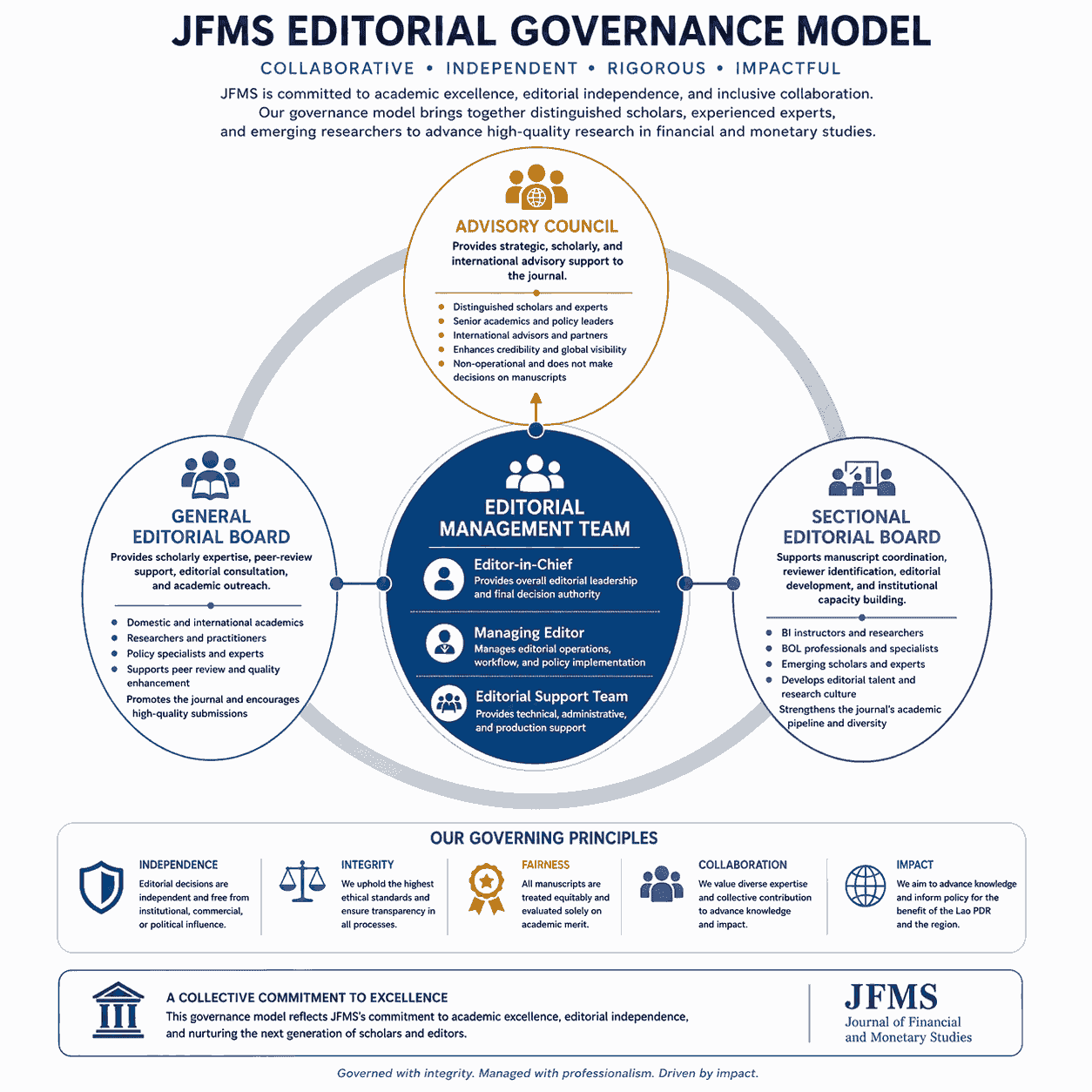
Editorial Structure of Journal of Financial and Monetary Studies (JFMS)
ADVISORY COUNCIL:
Prof. Phouphet Kyophilavong, Vice President of the National University of Laos (NUOL)
Prof. Hangtian XU, Vice Dean of School of Economics and Trade, Hunan University
EDITORIAL MANAGEMENT TEAM:
Editor-in-Chief: Dr. Thonmy Keokinnaly, Director General of the Banking Institute (BI), Bank of the Lao PDR (BOL)
Managing Editor: Dr. Sithong Chanthasouk, Acting Director of Training, Scientific Research, and Information Center (TRIC), BI
GENERAL EDITORIAL BOARD:
Assoc. Prof. Bounmy Inthakesone, Faculty of Economics and Business Management, NUOL
Assoc. Prof. Bounlert Vanhnalat, Faculty of Economics and Business Management, NUOL
Dr. Khaisy Srithirath, Faculty of Economics and Business Management, NUOL
Dr. Pakaiphone Syphoxay, Faculty of Economics and Business Management, NUOL
Dr. Sorphasith Xaisongkham, Ministry of Finance
Dr. Somvixay Chanthavong, Bank Supervision Department, BOL
SECTIONAL EDITORIAL BOARD:
Dr. Boungnuene Xaykeuyachongtoua, Banking Section, Bi
Dr. Chanthavone Phommathep, Finance Section, Bi
Dr. Vongphakone Vongsouphanh, Finance Section, Bi
Dr. Souksavanh Nouanpaseuth, Tric, Bi
Dr. Keoudone Keothephar, Banking Section, BI
Dr. Khoutseng Kongmany, Accounting Section, BI
Dr.Khamkiew Phandavong, Accounting Section, BI
EDITORIAL SUPPORT TEAM:
Mr. Souliya Phankham, TRIC, BI
Mr. Keophouthone Hathalong, Center for Scientific Journal Promotion, NUOL
Mr. Amnuay Vongdonedaeng, TRIC, BI
Mr. Kitthisack Keomixay, TRIC, BI
Ms. Moukdavanh Phiarath, TRIC, BI
The Journal of Financial and Monetary Studies (JFMS) is committed to academic excellence, editorial independence, and inclusive collaboration. Our robust governance model brings together distinguished scholars, experienced policy experts, and emerging researchers to advance high-quality research in financial and monetary studies.
The structural oversight of JFMS is organized into four interconnected bodies, supported by five core governing principles:
1. Core Editorial Structure
Editorial Management Team
The central operational engine of the journal, responsible for overall editorial leadership, workflow management, and policy implementation.
-
Editor-in-Chief: Provides strategic vision, strategic editorial leadership, and holds the final decision authority on all manuscripts.
-
Managing Editor: Manages the day-to-day editorial operations, journal workflow, peer-review coordination, and policy compliance.
-
Editorial Support Team: Provides vital technical, administrative, and production support throughout the publication lifecycle.
Advisory Council
A high-level body that provides strategic, scholarly, and international advisory support to elevate the journal's global visibility.
-
Composed of distinguished international advisors, partners, senior academics, and global policy leaders.
-
Focuses on enhancing the credibility and international positioning of JFMS.
-
Note: This council operates in a non-operational capacity and does not participate in individual manuscript decisions.
General Editorial Board
Provides the essential scholarly expertise and network to ensure the quality and integrity of published research.
-
Composed of domestic and international academics, seasoned researchers, practitioners, and policy specialists.
-
Actively supports the peer-review process, quality enhancement, and global academic outreach.
-
Promotes the journal globally to encourage high-quality submissions.
Sectional Editorial Board
Focuses on thematic coordination, institutional capacity building, and strengthening the academic pipeline.
-
Composed of BI instructors, BOL professionals, specialists, and emerging scholars.
-
Supports manuscript coordination, reviewer identification, and editorial talent development.
-
Fosters a progressive research culture and ensures academic diversity across the journal’s distinct thematic sections (Pillars).
2. Our Governing Principles
To guarantee the highest academic and professional standards, the governance of JFMS is anchored on five fundamental pillars:
-
Independence: Editorial decisions are strictly independent and entirely free from institutional, commercial, or political influence.
-
Integrity: We uphold the highest ethical standards and guarantee absolute transparency in all peer-review and editorial processes.
-
Fairness: All manuscripts are treated equitably and evaluated solely based on their academic and scientific merit.
-
Collaboration: We highly value diverse expertise and collective contribution to advance global financial knowledge and socioeconomic impact.
-
Impact: We aim to advance knowledge and directly inform policy frameworks for the tangible benefit of the Lao PDR and the wider region.
A Collective Commitment to Excellence
This governance model reflects JFMS’s unyielding commitment to academic excellence, editorial independence, and its mission to nurture the next generation of scholars and editors.
Governed with integrity. Managed with professionalism. Driven by impact.